
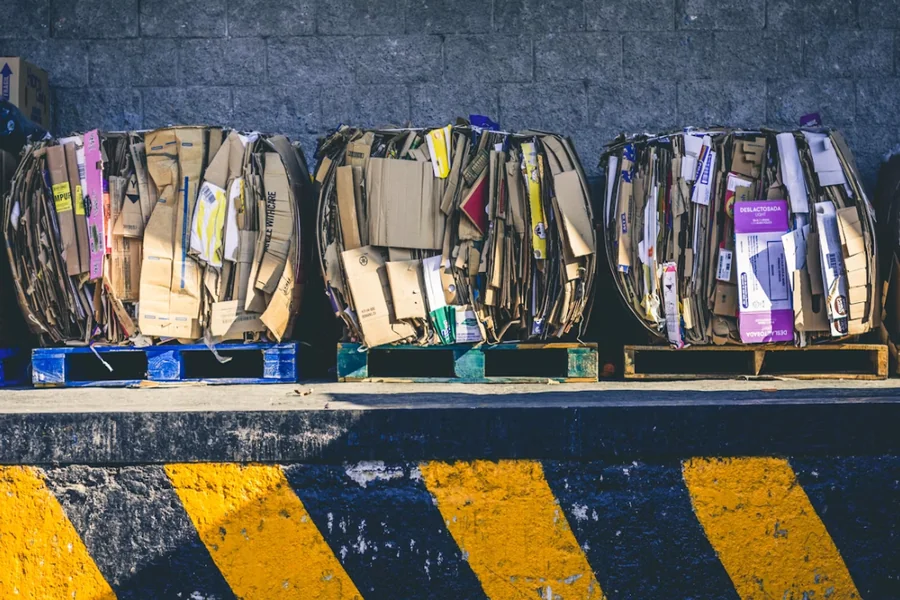

Walk through almost any warehouse or distribution center and you’ll spot the same thing piling up in the corners: cardboard, shrink wrap, and pallet strapping, waiting for someone to deal with it. It’s not glamorous, and it rarely makes it into a company’s sustainability report headline. But how a business handles that daily buildup says more about its environmental commitments than most glossy PR campaigns ever could.
Sustainability conversations tend to gravitate toward big, visible moves: solar panels, electric fleets, carbon offset programs. Waste handling rarely gets the same attention, even though it’s one of the few areas where operational efficiency and genuine environmental benefit line up almost perfectly.
That’s largely because dealing with waste properly used to mean either paying for frequent, costly pickups or accepting that a chunk of floor space would always be dedicated to overflowing bins. Equipment like the Balers and Compactors offered by Mil-tek has shifted that equation for a lot of businesses, compressing cardboard and plastic waste into manageable, sellable bales instead of letting it eat up square footage and staff hours.
Why This Matters More Than It Used To
Retailers and logistics companies have spent the past few years under growing pressure to show, not just claim, progress on sustainability. Investors ask about it. Customers notice it. Regulators are starting to require it. Municipal solid waste in the US has been trending upward for decades, and businesses are increasingly expected to demonstrate they’re not simply adding to that curve without doing anything about it.
According to the U.S. Environmental Protection Agency, total municipal solid waste generation reached 292.4 million tons in 2018, up from 268.7 million tons the prior year and far above the 208.3 million tons recorded in 1990. Numbers like that make it clear why waste reduction has moved from a nice-to-have to something closer to an expectation.
The Operational Case, Not Just the Ethical One
What makes this shift easier to justify internally isn’t just the sustainability angle, it’s the math. Compacted waste takes up a fraction of the space loose waste does, which means fewer collection runs, lower haulage costs, and often a new revenue stream from selling baled cardboard to recyclers instead of paying to have it hauled away.
There’s a labor angle too. Staff who’d otherwise spend chunks of their shift breaking down boxes or managing overflowing bins get that time back. It’s a small thing on any given day, but it adds up fast across a year, especially in high-throughput environments like grocery distribution or e-commerce fulfillment.
Practical Sustainability, Not Performative Sustainability
Part of what makes this kind of change appealing is how undramatic it is. Nobody’s issuing a press release because they installed a compactor. But that’s arguably the point. Sustainability that shows up in daily operations, in reduced truck trips and reclaimed floor space, tends to stick around longer than initiatives designed mainly to be photographed.
Mil-tek has built its business around that quieter version of sustainability: equipment that solves an immediate operational headache while nudging a company’s overall environmental footprint in the right direction. It’s not a substitute for bigger structural changes, but it’s a rare case where doing the responsible thing and doing the cost-effective thing point in exactly the same direction.
For businesses looking at their own waste handling with fresh eyes, that alignment might be the easiest sustainability win available, and one of the few that pays for itself.