
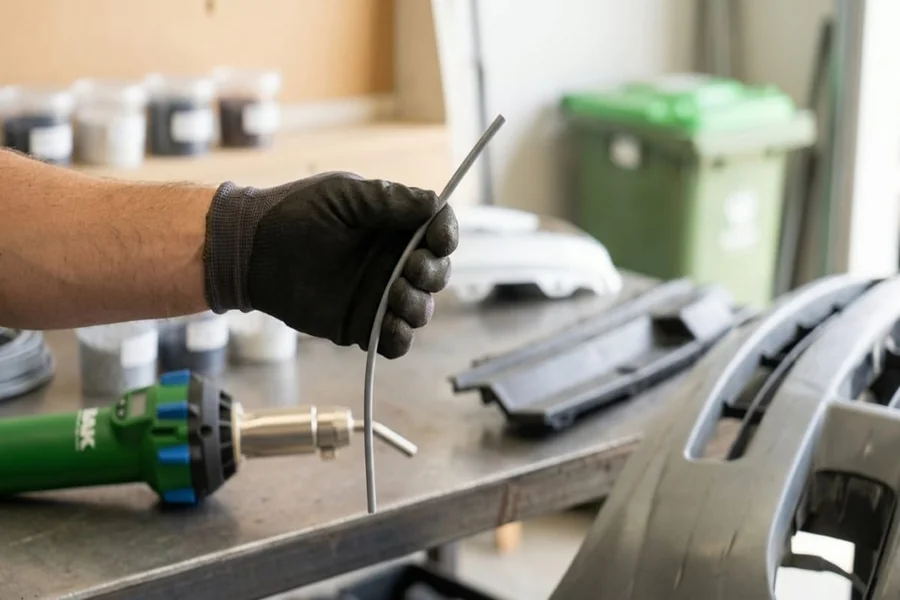

Choosing compatible plastic welding rods starts with identifying the base material, then checking the filler grade, dimensions and equipment requirements. Colour alone cannot confirm a suitable match. For Australian fabricators repairing components or assembling tanks and ducting, these checks help prevent weak joints, interrupted work and wasted material.
Identify the Base Material First
Check Markings and Material Records
Look for identification codes such as PP for polypropylene, PE-HD for high-density polyethylene and PVC for polyvinyl chloride. Check supplier documentation for the exact grade, particularly when components contain blends, reinforcement or other additives.
Two black components can contain different polymers. If markings are missing, seek material identification advice before choosing a filler or starting a repair.
Confirm Grade Compatibility
Start with filler made from the same polymer as the base material, then confirm the manufacturer’s compatibility recommendations. Matching polymer names alone may not establish suitability because grades and formulations can differ.
Where possible, use the filler recommended by the sheet or component manufacturer. Treat colour as an additional specification, rather than proof that the materials will weld successfully.
Match Plastic Welding Rods to Your Equipment
Selecting consumables for plastic welding also means checking how the tool feeds and applies the filler. Hot air speed welding requires a nozzle matched to the rod’s shape and dimensions. Extrusion welders have model-specific requirements for the material and rod sizes they accept.
Check Profile, Diameter and Joint Geometry
Confirm the required rod profile and diameter against the tool manual, nozzle specification and welding procedure before ordering.
A larger rod does not automatically produce a stronger joint. The filler size must allow suitable heating and placement within the prepared joint. Poorly matched dimensions can disrupt feeding or make consistent application difficult.
Verify the Choice with a Trial Weld
Prepare matching offcuts using the specified joint preparation and cleaning method. Follow the applicable welding procedure, using manufacturer guidance to establish suitable starting parameters.
Allow the trial weld to cool before assessing it with the test method required for the application. A smooth bead alone does not demonstrate adequate strength. If the sample fails, investigate material compatibility, preparation, equipment settings and technique before changing the heat.
Keep Filler Clean and Traceable
Store rods labelled, clean and dry, preferably in their original packaging. Separate polymers and grades to prevent mix-ups, and follow product-specific storage or conditioning instructions.
Summary
Before ordering, record the material grade, filler specification, and welding method. Contact Plastral to discuss equipment and consumables for your project.